
 Back
Back
That’s the reality for agronomy teams across the country, and it’s exactly what we dug into during our recent webinar, “Ease of ROI: How Efficiency Fuels Growth.” In this conversation, Taranis’ Chief Commercial Officer Jason Minton, Customer Experience Lead Jennifer Stutz, Regional Account Manager Tim Pearson, and Trevor Cox from Central Valley Ag (CVA) shared how retailers are turning time savings into measurable, repeatable ROI.
This blog pulls together the big ideas, real stories, and practical examples from that session.
As Jennifer put it, efficiency isn’t just a hot topic—it’s a lifeline.
Agronomy teams are being asked to:
All without adding more hours to the day.
Jason kicked off the session by tackling a common concern head-on:
“AI is not going to take anybody’s jobs. AI is going to make you better at the job you’re doing.”
Taranis does that by capturing leaf-level imagery of every acre and using AI to assess those images. Instead of just sending back “interesting pictures,” Taranis delivers summaries and maps that tell you:
You get actionable intelligence on every acre—before the grower even calls.
That’s where efficiency starts to become ROI.
Central Valley Ag has been working with Taranis for nearly eight seasons. Trevor Cox, ACS Regional Manager for Kansas at CVA, was honest about where they started:
At first, their agronomists were skeptical. New tech. AI. It felt risky.
So for the first couple of seasons, CVA built in ground-truthing:
After two seasons, something happened: they stopped needing that extra step.
“If it was saying the stand was this, we’d go out and confirm it. It was correct every time. If it said pigweeds were there, they were there. If it saw bugs, the bugs were there.” – Trevor Cox
Ground-truthing became repetitive and, frankly, unnecessary. Trust went up. Extra trips went down. And that’s when efficiency really kicked in.

When Taranis became part of the daily workflow, the first change CVA saw was capacity.
For high-touch agronomy customers, Trevor described a typical day before Taranis:
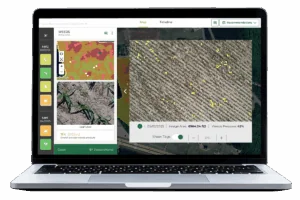
Now, that same agronomist starts the day by opening the Taranis dashboard:
“Now they can just select what’s the worst, go to the map, see the worst spot in that field, and go directly there. It’s much, much faster.” – Trevor Cox
For one CVA salesman managing a large dairy account, Trevor estimates that Taranis has saved:
Across the broader team, Trevor feels confident most agronomists are saving 5–7 hours a week in the busiest parts of the season—hours they’re now putting into:
Tim summed it up from his own 35 years in retail ag:
“If I can go home an hour or two earlier, sit at my kitchen table and go through Insights instead of spending three or four hours driving around for a ‘peek’ at fields—that’s a big deal.”
Capacity gains aren’t just about productivity. They’re also about employee retention and quality of life. It’s harder to burn out a team that has the right tools.
Efficiency isn’t just “faster.” It also makes decisions more precise and less wasteful.
Trevor shared several field-level examples from CVA and his own farm:
Traditionally, stand calls meant:
With Taranis:
“99% of the time, not all of that field needs to be replanted. It might just be a corner, or 50%. Now we know exactly where.” – Trevor Cox
On one of Trevor’s own farms:
He wasn’t putting residual down, so a targeted pass made agronomic and economic sense.
“That more than paid for Taranis right there. Only putting chemical on less than half the field.” – Trevor Cox
Because he was treating fewer acres, he also chose to increase the rate where weeds were present, leading to better control. More precise spend, better results.
Taranis doesn’t just show you where damage exists; it helps you connect it to thresholds.
Instead of clipping leaves and eyeballing charts, they see:
“On our farm, we haven’t sprayed insecticides since we started using Taranis, just because it was always less severe than we thought. With the bird’s eye view, we could see it wasn’t justified.” – Trevor Cox
That’s real, measurable product savings, driven by data—not by pulling back blindly.
Jason introduced hard savings as a critical, and often overlooked, part of ROI.
Retailers tend to focus first on:
Those are all important. But hard savings matter, too:
As Tim shared, one retailer he worked with years ago calculated it cost $500 every time a truck pulled into a grower’s driveway once you accounted for:
The question becomes: What are you doing with that $500?
“How do we make that $500 meaningful instead of ‘What do you think about the weather today?’ conversations?” – Tim Pearson
Taranis helps make each visit intentional:
Hard savings are also hiding in employee retention, which is harder to quantify but just as real.
Trevor was candid:
“For the amount of hours one of our salesmen was putting in, I kind of doubt he’d still be here if it wasn’t for Taranis.”
Keeping good people on the team is one of the most valuable “hidden ROIs” of all.
One of the clearest themes from Tim and Trevor was how Taranis changes the tone of conversations between advisors and growers.
Instead of:
They’re having conversations about:
“The conversations are much more agronomically based. You’re talking solutions, not just price. You’re no longer just a price tag.” – Trevor Cox
Growers are noticing. Some even tell CVA they use Taranis for the sales team’s sake, because they see how it improves recommendations and saves money over the long run.
Tim put it simply:
“Ag is the ‘get-it-right’ business. The folks offering the highest level of service with real data don’t have to win by being the cheapest. They win by being right.”
So why is a tool like Taranis a necessity and not just a “nice-to-have” when margins are thin?
Trevor didn’t mince words:
“You can’t make blind decisions anymore. With the amount of money guys are spending on inputs, it’s a stupid decision to just throw thousands of dollars on the ground not knowing if it’s needed.”
Taranis:
Sometimes, the right move is not to spend money. That’s still ROI.
Trevor shared that some growers initially felt like they didn’t “get their money’s worth” in seasons where they didn’t find major problems. His response:
“Isn’t that a good thing? You didn’t have significant issues. You didn’t need to spend an excess amount of money—and you knew that with concrete data.”
Peace of mind is a form of ROI, too.

As we wrapped the webinar, Jason brought it back to what really matters:
Taranis delivers actionable, leaf-level intelligence on every acre so agronomy teams can:
“Efficiency doesn’t just save time; it creates opportunity.” – Jennifer Stutz
If you’re already using Taranis, Jason challenged partners to do one more thing this year: measure your ROI—not just in product sales, but in capacity gains, hard savings, and retention.
If you’re not using Taranis yet, now is the time to ask:
And how much could change if your team knew exactly what was happening on every acre—before they ever left the driveway?

Customer Success Rep Cory Edge talks with Taranis CTO Gershom Kutliroff about leaf-level AI, field accuracy, and turning imagery into confident in-season decisions.
Grower loyalty depends on strong recommendations. Learn how Taranis helps retailers drive better decisions with AI and leaf-level insights.